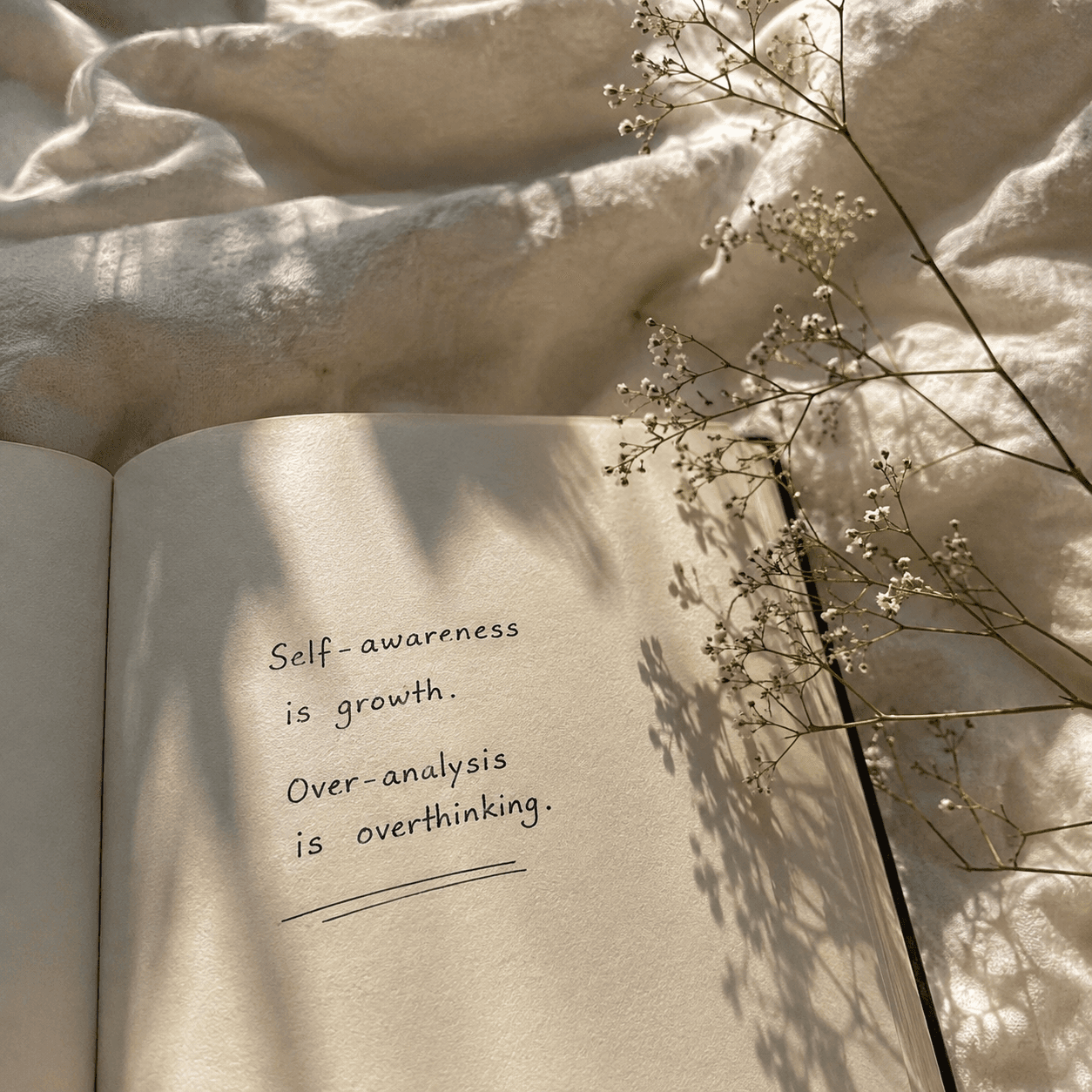
Self-awareness is genuinely useful — until it quietly becomes self-surveillance, and every feeling turns into something to diagnose. This post sits with the difference between reflection that helps and analysis that just keeps the loop running.
When Self-Awareness Becomes Self-Surveillance
The Trap Inside the Culture of Reflection
How to Tell Which One You're Actually Doing
Giving Your Mind Permission to Be Quiet
How do I know if I'm being self-aware or just overthinking?
Self-awareness tends to leave you feeling more grounded — you understand something and move forward. Overthinking loops: you keep asking the same questions without landing anywhere, and the analysis itself becomes the source of anxiety. If reflecting on a feeling makes it louder instead of clearer, that's usually a sign you've crossed into over-analysis.
Why does trying to understand my emotions sometimes make me feel worse?
Because not every emotion needs a root cause before you're allowed to let it pass. When you treat every discomfort as a puzzle to solve, you stay in your head instead of moving through the feeling. Some emotions just need space and time — not a diagnosis.
Is overanalyzing everything a sign of anxiety?
It can be. Compulsive self-analysis — where you can't rest until you've explained every reaction — often runs on the same engine as anxiety: the belief that understanding equals safety. It's worth noticing whether the analysis actually settles you or just keeps you busy. If it's the latter, talking it through with someone, or seeing a therapist, can help.
Can you be too self-aware?
You can engage in too much self-monitoring, yes. Healthy self-awareness is a tool you pick up when it's useful. When it becomes constant — a running internal commentary on every thought, feeling, and reaction — it stops being insight and starts being noise. The goal isn't to understand every part of yourself all the time; it's to live more freely, not less.
How do I give myself permission to just feel something without analyzing it?
Start by noticing when the analysis kicks in and asking whether it's actually helping right now. Sometimes the most useful move is to name the emotion simply — 'I'm sad,' 'I'm irritated' — and then let the body catch up without chasing the why. It feels uncomfortable at first, especially if reflection has been a coping habit for a long time.