You've spotted the opportunity, you know you want it, and somehow you still find a way not to take it. Self-sabotage is one of the stranger things the human mind does and understanding why it happens is a lot more useful than just trying harder to stop.
When You're the One Getting in Your Own Way
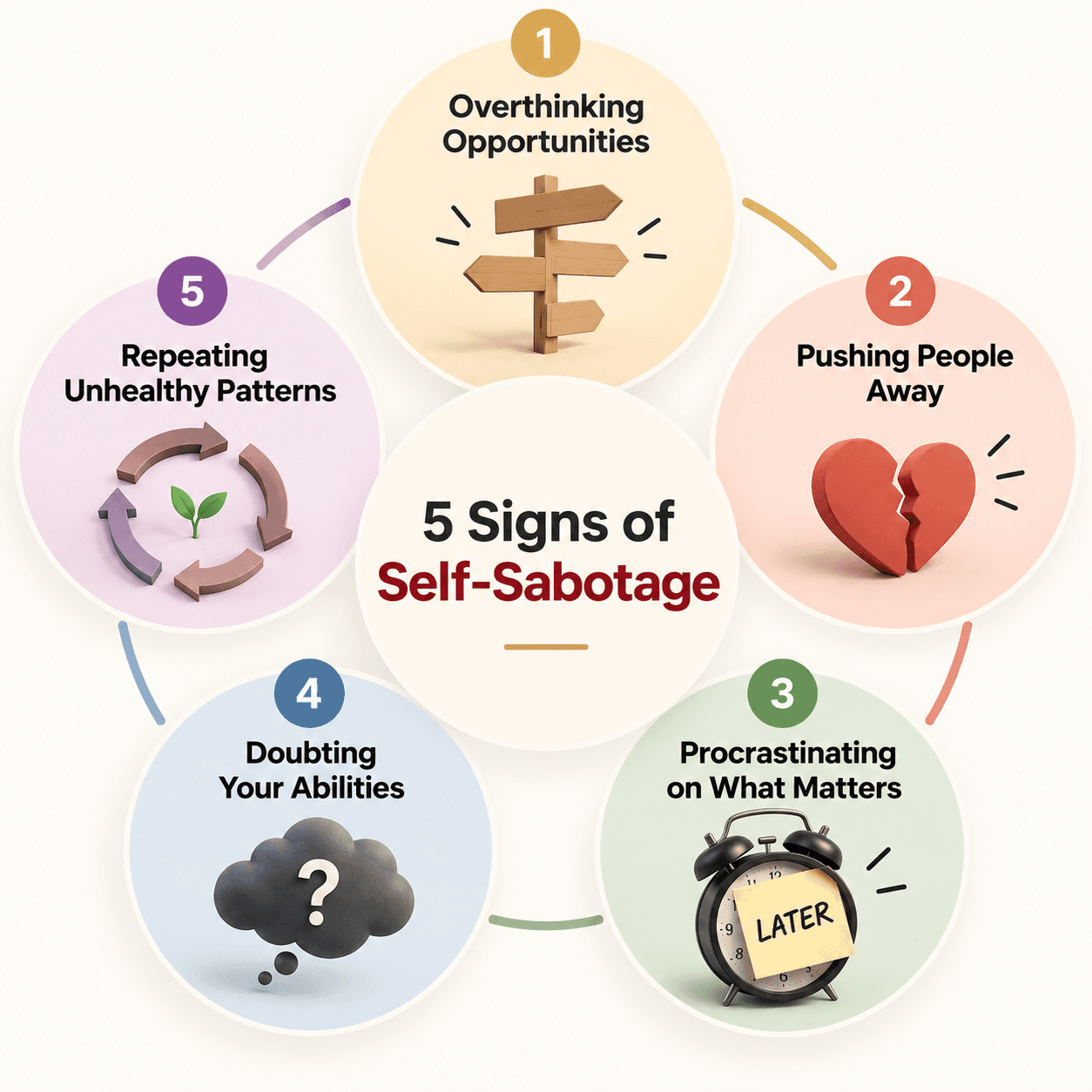
Five Signs It Might Be Self-Sabotage
Why We Do It: Protection, Not Failure
Starting to See It Differently
How do I know if I'm self-sabotaging or just genuinely not interested?
Ask yourself whether the hesitation shows up specifically when something starts to go well a relationship that feels too good, a job that actually fits, a goal that's within reach. Avoidance tied to fear tends to spike when things get real, not when they're still abstract. Genuine disinterest is usually quieter and more consistent.
Why do I keep repeating the same patterns even when I know they're hurting me?
Because familiarity is its own kind of comfort. Patterns we've had for years even painful ones feel predictable, and predictability feels safe to the nervous system. Knowing a pattern is harmful doesn't automatically override the pull toward what's familiar. That's not a character flaw; it's just how deeply worn grooves work.
Is self-sabotage always unconscious, or can I be doing it on purpose?
Usually it starts unconscious you're not sitting down to ruin your own chances. But sometimes, once you've noticed the pattern, you'll catch yourself mid-sabotage and keep going anyway. That's the moment self-awareness alone isn't enough, and talking through what's underneath it with a friend, a therapist, or someone outside the situation tends to help more than willpower.
Can self-sabotage actually be a form of self-protection?
Yes, and this is worth taking seriously. Behaviors that look like self-destruction from the outside often started as reasonable adaptations to something painful rejection, failure, betrayal. Withdrawing before someone can leave, not trying so you can't be told you failed. The protection made sense once. It's just outlasted its usefulness.
What actually helps with self-sabotage, beyond just 'being more self-aware'?
Self-awareness is genuinely the starting point you can't change what you can't see. But it usually needs a companion: saying the pattern out loud to another person, sitting with the discomfort instead of immediately escaping it, and taking small actions toward the thing you're avoiding before the fear fully passes. Waiting to feel ready is often its own form of the delay.