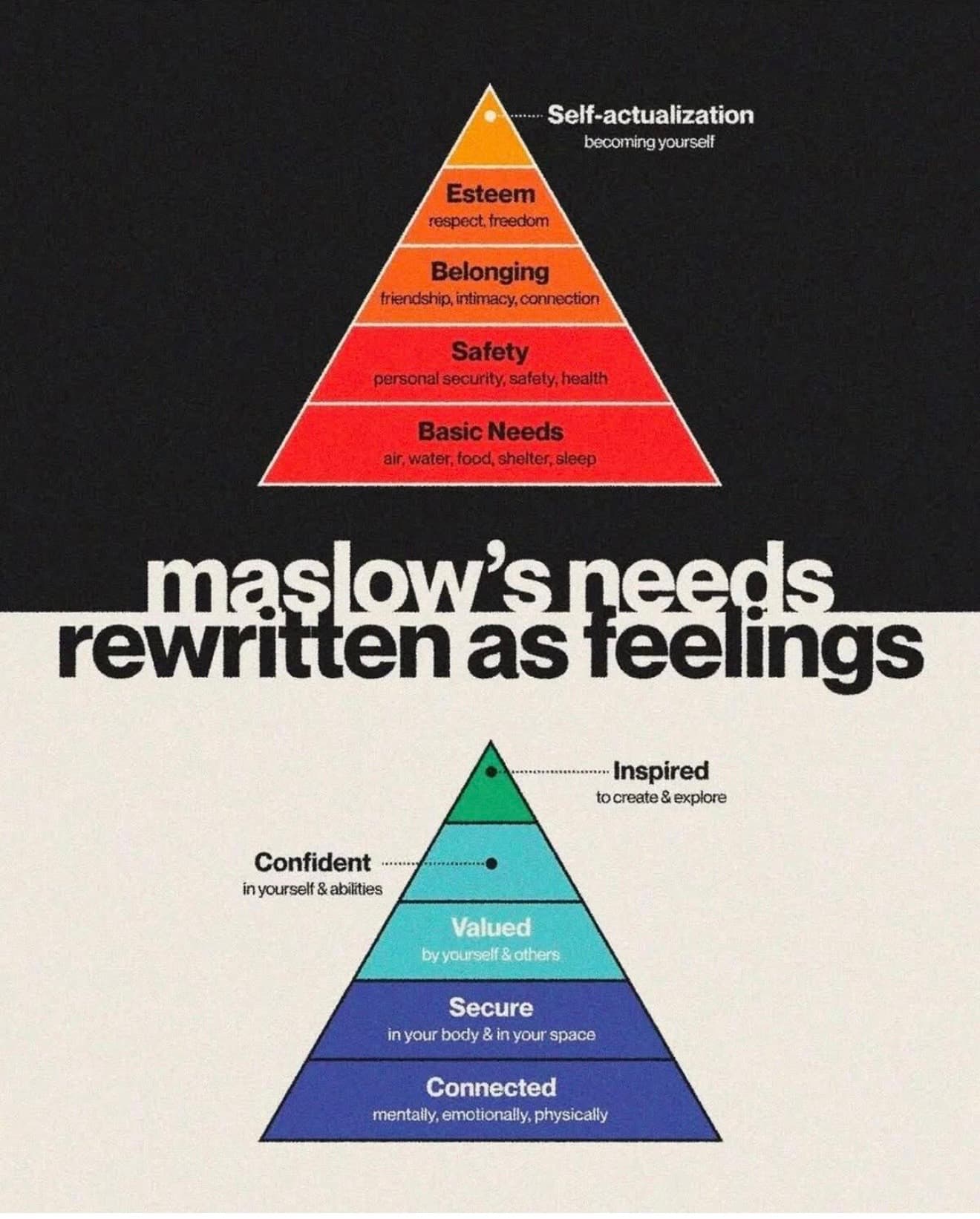
Maslow's hierarchy gets taught as a fixed ladder of needs but it maps surprisingly well onto the emotional states that actually shift how we feel day to day. What changes when you read it less as "what we need" and more as "what helps us feel safe, connected, valued, and alive to possibility."
The Ladder Nobody Actually Climbs in Order
Maslow's hierarchy is one of those frameworks everyone vaguely remembers from school the pyramid, the tiers, physiological at the bottom, self-actualisation at the top. The standard reading is that you work your way up: survive first, then belong, then grow.
But human experience is messier than that. People in genuinely precarious situations still find moments of creativity, connection, and meaning. And people with every material need covered can feel completely stuck, flat, or unable to move. The strict ladder doesn't hold up to much scrutiny — and modern psychology largely agrees that the rigid tier-by-tier version was always more diagram than fact.
What does hold up is the underlying shape: that different conditions seem to produce different emotional states, and that some of those states make others more accessible. That's worth paying attention to, even if the pyramid itself is an oversimplification.
Five Emotional States Worth Actually Tracking
Read less as a fixed hierarchy and more as a map of what different conditions tend to produce, the framework becomes genuinely useful. Roughly:
• Connected — feeling emotionally, mentally, and physically received by people and environment around you.
• Secure — feeling safe in your body and your circumstances, without a low-grade alarm running in the background.
• Valued — feeling respected, by others and by yourself.
• Confident — trusting your own abilities enough to act without constant second-guessing.
• Inspired — having the psychological space to create, explore, and grow into something.
These aren't destinations. They fluctuate — sometimes day to day, sometimes hour to hour — depending on circumstances, relationships, stressors, and what's been happening in your body. When security and connection are shaky, confidence and inspiration tend to become much harder to access. That's not a personal failing. It's just how the system works.
If you want a faster diagnostic version of this — checking which layer is actually missing on a rough day —
The Maslow-Hierarchy Check-In walks through it practically.
The Better Question to Ask Yourself
The common instinct when something feels wrong is to ask: what's wrong with me? It's almost never the most useful question. It tends to locate the problem inside a person rather than inside a set of conditions and conditions are usually what's actually in play.
The more honest question is something like: what do I need in order to feel safe, connected, valued, and able to grow?
That's not a reframe for the sake of being gentle. It's a more accurate diagnosis. If you don't feel connected, the intervention is probably relational someone to actually hear you, not a solo coping strategy. If you don't feel secure, the intervention may be environmental or situational, not cognitive. Matching the response to the actual gap is what makes it work.
Sometimes what's missing isn't insight it's somewhere honest to say it out loud. A trained listener at LissnUp is one specific option for that: an anonymous adult with no stake in your situation, there to receive whatever you're carrying without judgment or advice you didn't ask for.
Why This Is a Social Question, Not Just a Personal One
One of the quieter implications of reading the hierarchy this way: the emotional states it points to aren't just produced by individual effort. Connection requires other people. Security depends partly on environment and circumstance. Feeling valued involves how others actually treat you.
This matters because a lot of mental health advice is aimed at what an individual can do habits, mindset shifts, coping tools. And those things help. But they work better when the social and environmental conditions are also being considered. You can't fully think or habit your way to feeling connected if genuine connection is absent. The individual and the context are both part of the picture.
Asking 'what do I need?' rather than 'what's wrong with me?' opens the door to that fuller picture and usually points toward something more actionable than self-critique ever does.