Most self-care advice points at a single fix sleep more, exercise, take a break as if one good layer is enough. This post borrows the Swiss Cheese Model to explain why wellbeing actually works, and what to do when your usual go-tos stop holding.
Why One Layer Is Never Enough
We tend to think of self-care as a single, corrective act. Take a vacation. Get more sleep. Start going to the gym. Pick the right one and the problem gets solved.
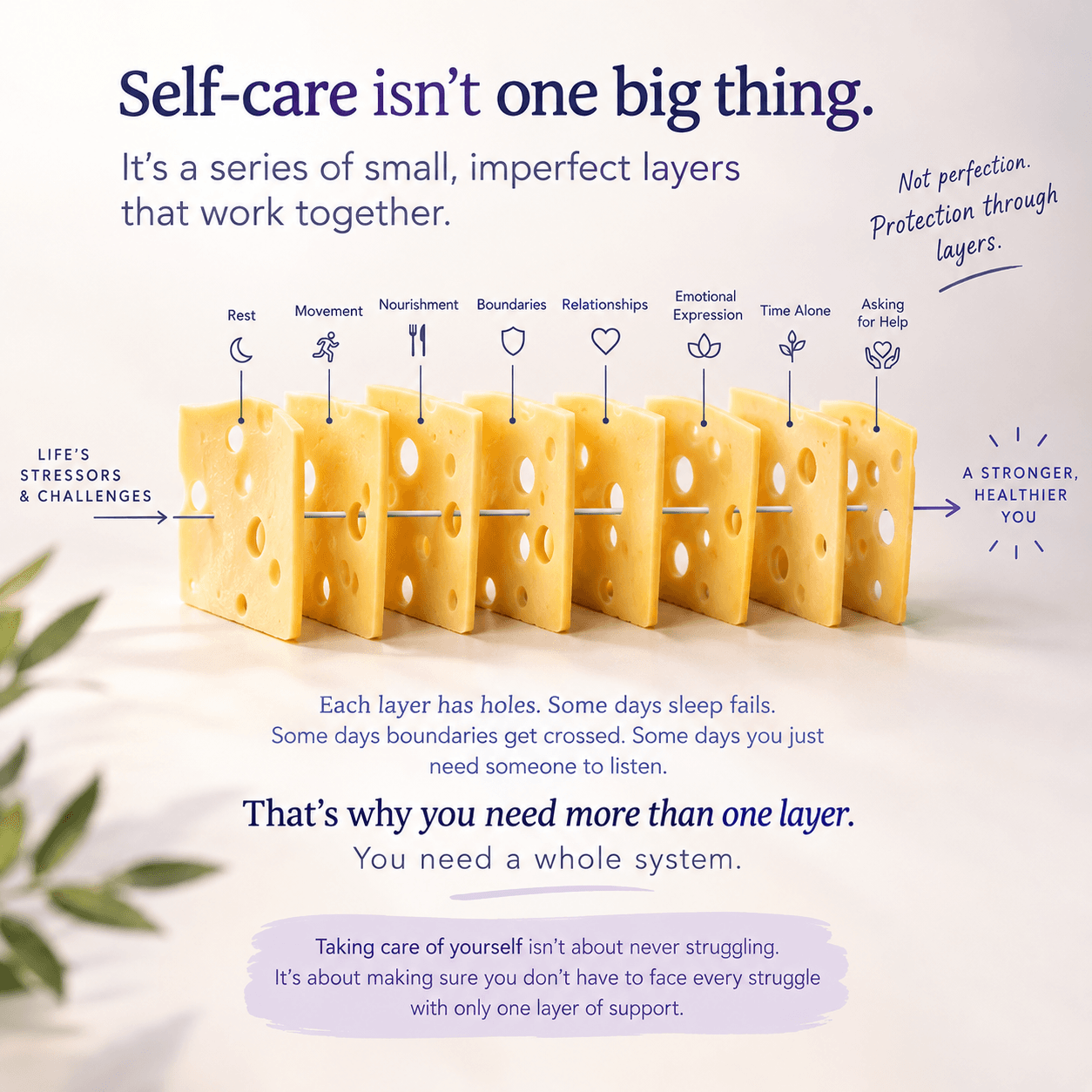
It doesn't really work like that and the Swiss Cheese Model is a useful way to see why. Originally used in aviation and healthcare to explain how accidents happen, the model describes a system of protective layers, each with holes. Any single layer has gaps. Stack enough layers and the holes rarely line up the system holds even when individual parts fail.
Your wellbeing works the same way. Sleep is a layer. Movement is a layer. Nourishment, connection, boundaries, quiet time, emotional expression each one a layer, each one imperfect. The goal isn't to find the one layer with no holes. It's to have enough of them that when one fails, something else catches you.
What the Layers Actually Are
Here's what a reasonably complete stack looks like:
• Rest sleep and genuine downtime, not just hours in bed scrolling.
• Movement exercise, yes, but also walking, stretching, anything that gets you out of your head and into your body.
• Nourishment food that sustains you, not punishes or rewards you.
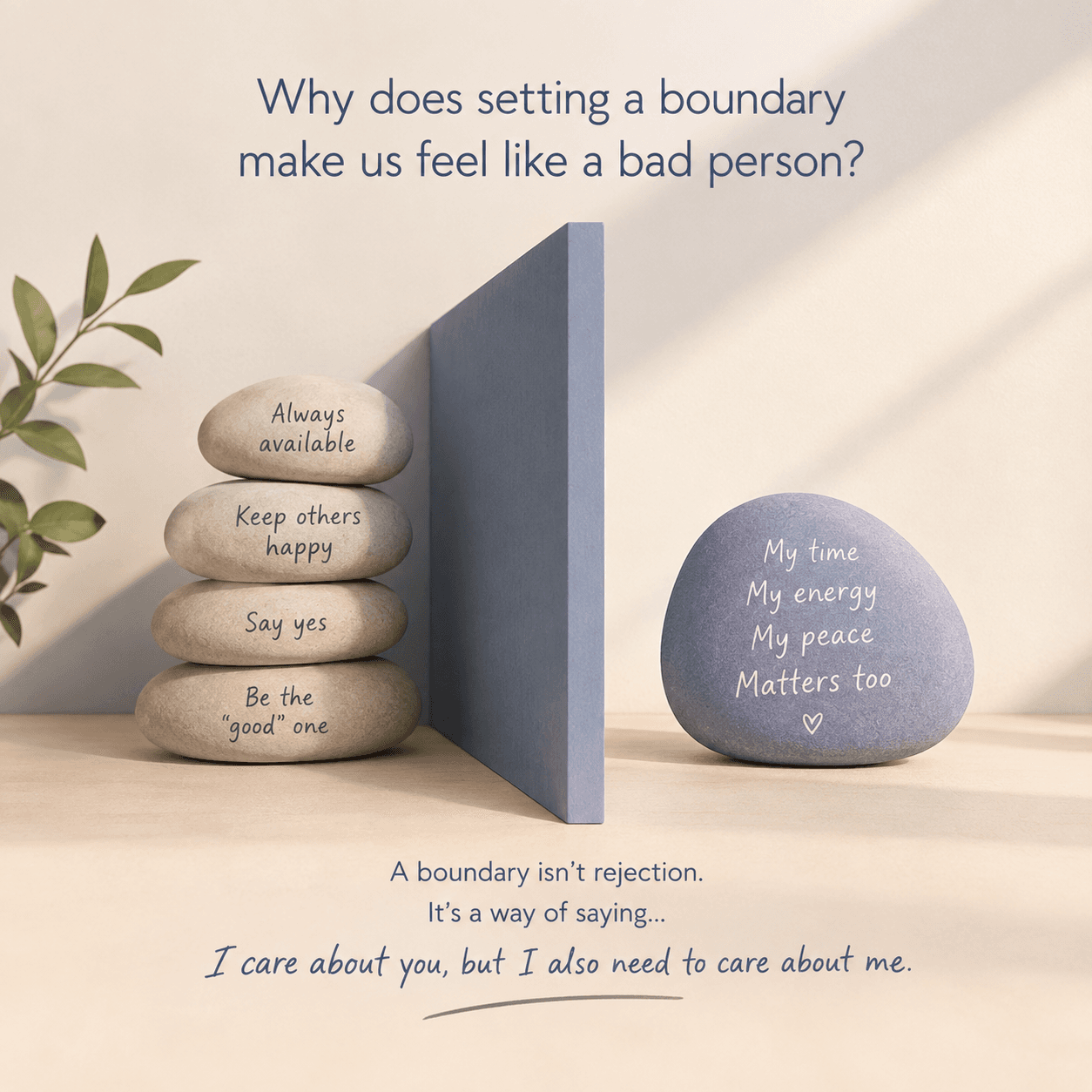
• Boundaries protecting your energy from the things and people that consistently drain it.
• Meaningful relationships connection with people who actually see you, not just proximity to other humans.
• Time alone genuine solitude, not isolation by circumstance.
• Emotional expression saying the thing, writing it down, moving it out of your body somehow.
• Asking for help the layer most people skip until they're desperate.
None of these are optional extras. And none of them substitute for the others. Healthy food supports you, but it can't replace real connection. Exercise can reduce stress, but it can't resolve the situation causing it. Quiet time gives your mind room, but life will still hand you difficult moments.
That's not a failure of any single practice. That's just what holes look like.
The Layer Most People Skip
Of all the layers, emotional expression and asking for help are the ones that tend to go untended the longest. They're also the ones that, when neglected, make every other layer less effective.
Carrying something unspoken is metabolically expensive. It takes energy that could otherwise go toward rest, connection, and recovery. And yet the instinct is often to wait to reach out only once every other layer has failed, once the situation is undeniable. That's backwards.
Saying 'I'm not okay today' is itself a layer of self-care. Doing it early, before you've hit the floor, is what makes the whole system more resilient. A trained listener at LissnUp is one specific way to tend to that layer an anonymous, judgment-free space to say what you're carrying out loud, without needing to manage anyone else's reaction while you do it.
If you're curious why being heard does something that other forms of self-care don't,
this post on why being heard can feel more healing than getting advice gets into the specifics.
Building the Net, Not the Ceiling
The question worth sitting with isn't 'what can I do to feel better today?' though that's not a bad question. It's closer to: which layer is currently thinnest, and what would actually address that?
If you're sleeping fine but still feel hollowed out, sleep isn't the gap. If you're socially busy but depleted, connection might not be what's missing solitude or boundaries might be. The layer that's failing is usually the one you keep telling yourself you can do without.
You don't need a perfect self-care routine. You need several imperfect habits that cover different needs and catch you when one of them slips. That's what a safety net actually is not one strong rope, but many, woven together.
The next time your usual go-to stops working, that's not a sign you're beyond help. It's a sign you're down to one layer, and it's time to add another.