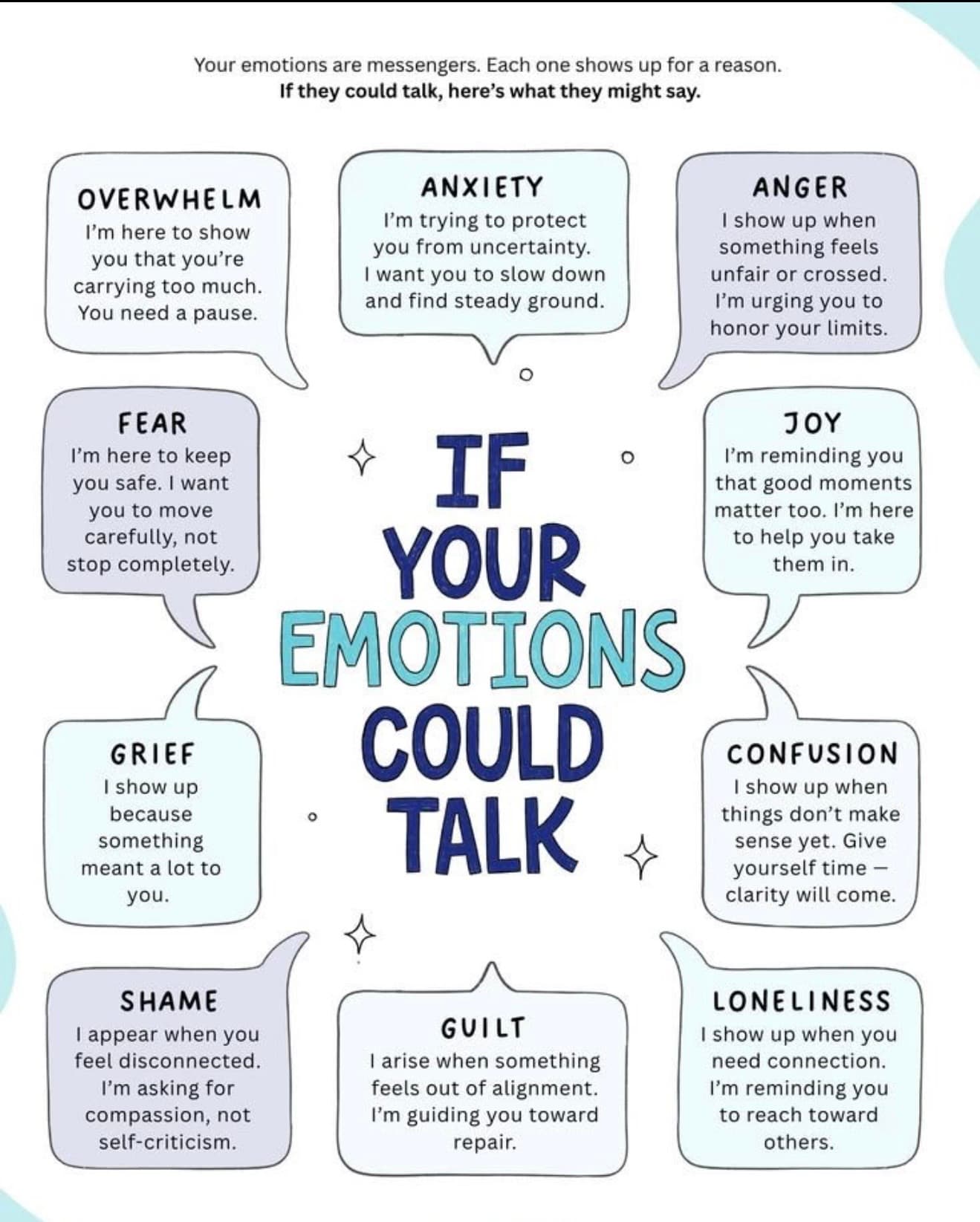
Emotions aren't always accurate reports of what's happening. They are almost always worth listening to. Anxiety, anger, grief, shame — each one carries a signal about what your inner system is registering. Here's a short guide to what yours might be trying to say.
Emotions Are Signals, Not Verdicts
You feel it before you can name it — a tightness in your chest, a flare of irritation, a heaviness that arrives out of nowhere. The reflex is to categorize the feeling as good or bad and then either indulge it or push it away.
A more useful frame: emotions are signals your internal system is sending you about what it's registering. They're not always accurate reflections of reality — anxiety can misjudge risk, grief can outlast the fresh loss, shame can attach to things that don't deserve it. But they're almost always worth paying attention to, because underneath every emotion is information about something in you that needs noticing.
The question isn't 'how do I stop feeling this.' The question is 'what is this trying to point me at.'
What Each One Is Probably Signaling
A short guide to some of the most common emotions and what they tend to be pointing at. None of this is diagnostic; all of it is worth checking against your own experience.
Anxiety
Usually signals uncertainty or perceived threat. In reasonable doses it prompts preparation. When persistent, it tends to overestimate risk relative to actual danger — which means the intervention isn't more analysis, it's addressing whatever's keeping the alarm system revved.
Anger
Usually arises when a boundary, value, or sense of fairness has been crossed. It's information about what you care about, delivered forcefully. Not inherently destructive — how you respond to it decides what it does in the world.
Fear
Points at potential danger and, in reasonable amounts, supports survival. Disproportionate fear can quietly shrink your world by rerouting you around things that would actually be fine. Worth interrogating when it's making decisions for you.
Overwhelm
Signals that cognitive or emotional demand has exceeded current capacity. Almost always an invitation to pause, reduce input, and ask for support — not to push through harder. Pushing through overwhelm reliably compounds it.
Grief
Reflects the size of what's been lost. It's not something to move on from; it's something to move with, at your own pace, as you adapt to a life shaped differently than the one you had. Grief that gets pushed down doesn't stay down.
Loneliness
Signals a specific kind of gap — between the connection you have and the connection you need. It isn't the same as being alone, and it doesn't respond to more casual interaction. It responds to actual felt contact with another person.
Guilt
Points at a behavior that conflicts with your values. In reasonable doses it motivates accountability and repair — genuinely useful. When it becomes chronic and untethered from specific behavior, it usually needs a different lens.
Shame
Differs from guilt in a load-bearing way. Guilt says 'I did something wrong.' Shame says 'there is something wrong with me.' Chronic shame is one of the more damaging emotional experiences to carry — Brené Brown's research and clinical shame research more broadly consistently link it with poorer mental health outcomes. Self-compassion is the well-supported counter-move.
Confusion
Often shows up when existing beliefs no longer fit your current experience. Uncomfortable, and also the specific state that most learning starts from. Confusion isn't failure to understand — it's the beginning of updating.
Curiosity vs. Judgment
Most people relate to their difficult emotions with judgment — trying to fix them, argue them out of existence, or wait them out. That approach has a specific cost: it teaches you to distrust your own inner signals, which is one of the ways people gradually stop knowing what they feel.
The alternative is curiosity. What's this feeling actually pointing at? What has it been showing up in response to? What would it look like to take the signal seriously instead of arguing with it? None of this requires the feeling to be logical or convenient. It just requires you to stop treating your emotions as problems to be managed and start treating them as information. If you want the mechanics of that pause,
the RAIN method is a workable practical tool.
When You Need Somewhere to Actually Hear Them
Emotions get clearer when you say them out loud to a person who receives them. That's the affect-labeling effect — naming a feeling to another person, without needing them to fix it, reliably reduces the feeling's grip while sharpening your sense of what it was about.
A trained listener at LissnUp is one specific option for that: an anonymous adult whose whole role is to receive what you say, without trying to reroute it, correct it, or turn it into their material. Not therapy and not a substitute for one when the feelings are big — just the specific input that helps you hear what your own emotions are trying to tell you.