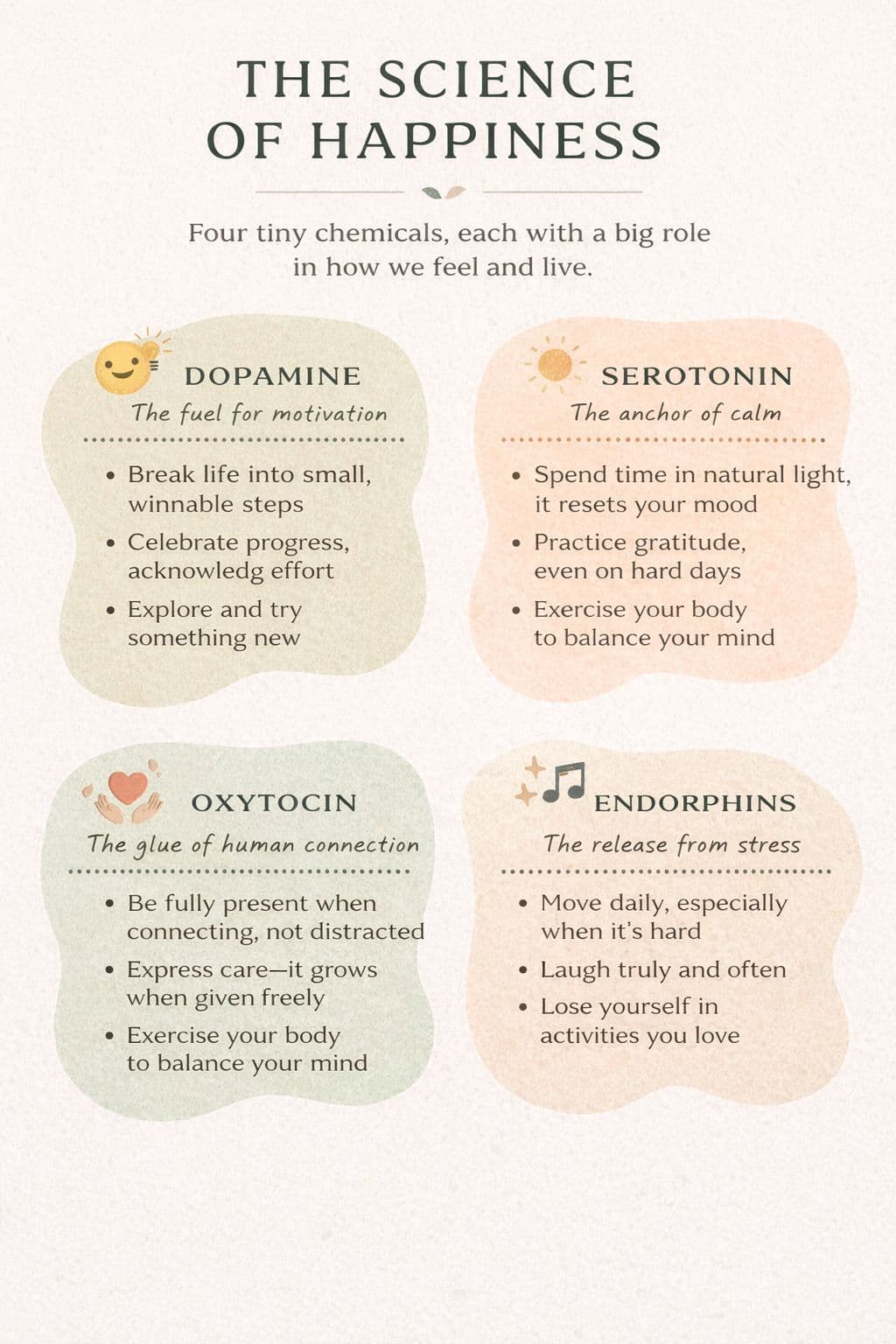
You've seen the 'four happy chemicals' explainer — dopamine, serotonin, oxytocin, endorphins, and the tidy list of habits for each. Most of it is roughly true and dramatically oversimplified. Here's the honest read on what these neurotransmitters actually do and what actually moves the needle on wellbeing.
Why This Framing Feels So Satisfying (And Where It Falls Short)
The 'four happy chemicals' framework — dopamine for motivation, serotonin for calm, oxytocin for bonding, endorphins for effort — is one of the most common wellness explainers on the internet. It's tidy, it's memorable, and it's roughly true in a limited sense. Each of these neurotransmitters is real, plays a role in different aspects of emotional experience, and can be nudged by specific behaviors.
What's also true is that this framing is a dramatic simplification of a system that has hundreds of interacting neurotransmitters, receptor subtypes, and feedback loops. Dopamine, in particular, is misunderstood almost every time it gets discussed casually — it's not really 'the reward chemical,' it's more accurately about motivation and prediction. And the specific 'hack this chemical with this behavior' guidance often outruns what the underlying research actually supports.
Still, the general direction of the advice is usually fine. This piece is about what parts to actually take seriously.
Dopamine: Not Reward, More Like Motivation
Dopamine's popular reputation as 'the reward chemical' is not quite accurate. The current neuroscience picture, roughly, is that dopamine tracks the anticipation of reward and the discrepancy between expected and actual outcomes — it's more about pursuit than satisfaction.
The practical implication is that things that move dopamine in a sustainable direction aren't dopamine 'hits' — they're the small, consistent progress that keeps the anticipation-of-reward system engaged. Setting workable goals, acknowledging your effort, and staying curious about things you care about are all reasonable behaviors regardless of the neuroscience story. Don't chase dopamine spikes — those tend to backfire (which is a large part of what makes social media, gambling, and short-form video so effective at hijacking the same system).
Serotonin: Real, But Its Popular Story Is Overstated
Serotonin is the neurotransmitter most commonly linked to mood regulation — the Harvard Health summary describes it as involved in mood, appetite, and sleep, and notes that abnormally low serotonin function is associated with depression and anxiety.
The honest complication is that the 'chemical imbalance' framing of depression that dominated pop-science for decades has been substantially walked back by researchers. Depression isn't reducible to low serotonin. That said, the behaviors popularly recommended for serotonin — getting sunlight, exercise, sleep on a schedule, gratitude practices, meaningful social contact — do all have real independent evidence for supporting mood, whether or not the pathway is exactly what the popular story claims. Do the behaviors. Hold the mechanism loosely.
Oxytocin: The Cuddle-Hormone Story Is Half-Right
Oxytocin is real, it's involved in social bonding, and it does rise during physical closeness, breastfeeding, and moments of trust. The 'cuddle hormone' story is not made up.
The complication is that oxytocin's effects are more context-dependent than the popular framing suggests — the same molecule that facilitates bonding with your in-group also seems to sharpen out-group boundaries in some contexts. It's not a universal 'love drug.' What's honest to say is that consistent, safe social contact — being present with people, being empathetic, being touched by people who love you — is genuinely good for humans, and the underlying biology involves oxytocin among many other things.
Endorphins: The One That's Cleanest
Endorphins are the neurotransmitter with the tightest link between the popular story and the actual research. They're the body's endogenous opioid-like molecules, they rise with sustained physical exertion (the 'runner's high' is real if incomplete), they're released with laughter, and they do genuinely reduce the perception of pain.
The advice — move your body, laugh, do absorbing physical things — is straightforwardly good regardless of the neurochemical story. This is one place where 'do the thing to get the effect' isn't oversimplified.
The Honest Summary
The 'four happy chemicals' framework is a useful mental model, not a literal instruction manual. The practical advice it produces — small goals with real progress, sunlight and movement and sleep, being genuinely present with people you care about, exerting yourself physically and laughing regularly — is basically correct even where the underlying neuroscience is oversimplified.
What won't be found in any of these systems is a shortcut that avoids the boring stuff. If you're looking for the specific pieces on the connection side (which is under-appreciated relative to sunlight and gym-going),
why empathy is the load-bearing skill under the others is the sibling read.
And if what you're navigating is closer to 'nothing feels good anymore' than 'I could feel a bit better,' that's a different situation than a happiness-hack article can address — persistent flatness for weeks is worth taking to a clinician regardless of what any wellness content tells you about your dopamine baseline.
Where Talking Fits Into All of This
One thing the four-chemicals framing misses is that a lot of what supports wellbeing isn't chemical management at all — it's the experience of being heard by another human. A trained listener at LissnUp is one specific option when that particular input has been missing from your week: an anonymous adult whose whole role is to receive what you have to say without judgment, without a fix, without an agenda. Not therapy and not a substitute for one — just the specific 'someone to talk to' input that's harder to arrange in modern life than any of the biological ones.